Vietnam Entry Handbook
The visa, customs and airport rules that decide whether you clear immigration in four minutes — or spend three hours wishing you had read something first.
Three ways a Vietnam trip goes wrong
All three are common. All three are entirely avoidable, and all three are decided before you reach the airport.
Your vape is confiscated
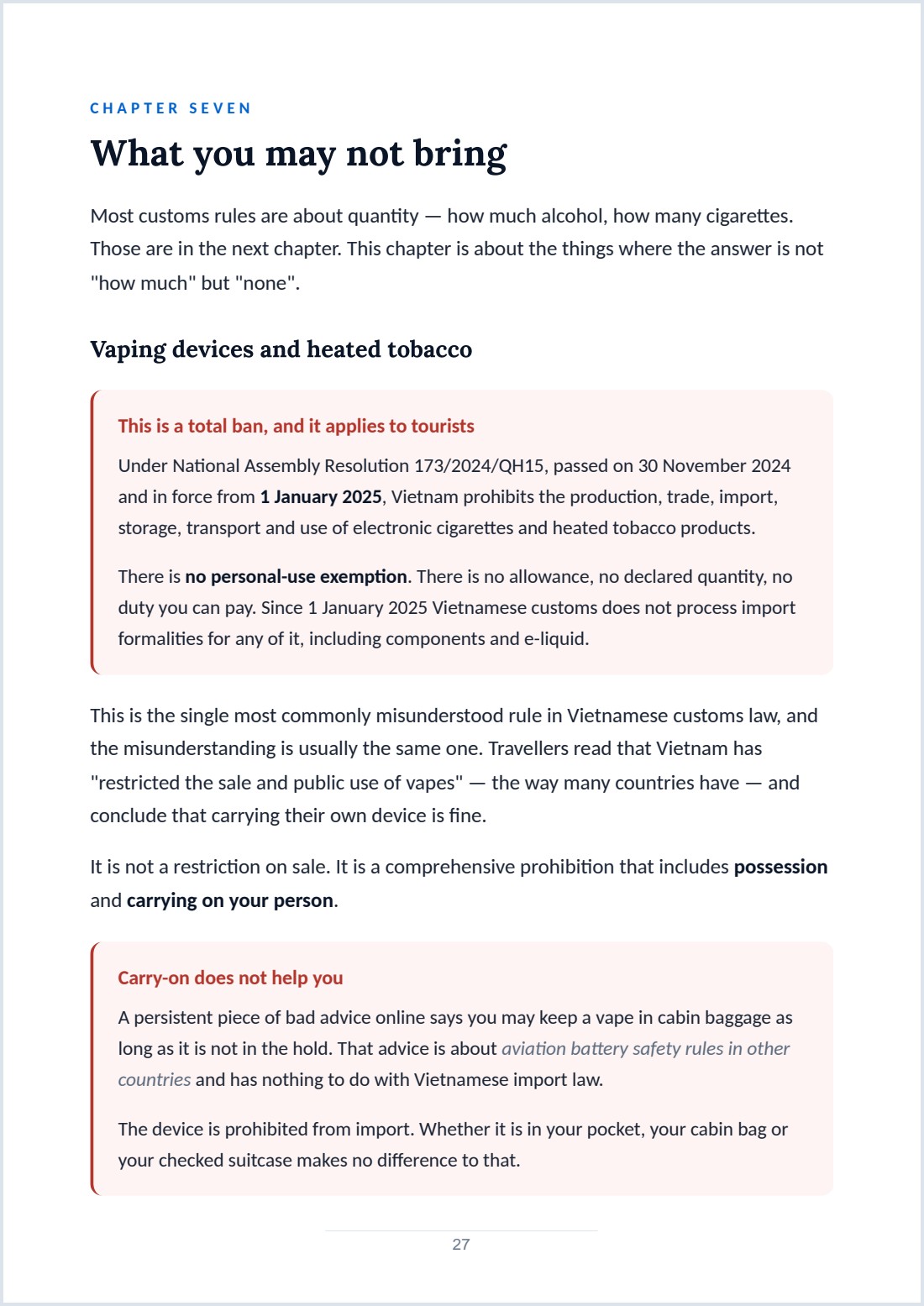
Vietnam banned e-cigarettes and heated tobacco outright in January 2025 — production, import, storage and use. There is no personal-use exemption, and no carry-on loophole. Most travellers have no idea.
You lose two months of your stay
An e-visa runs from the date it is issued, not the date you enter. Apply too early and a 90-day visa quietly becomes a 29-day one. People discover this at the desk.
You miss your domestic flight
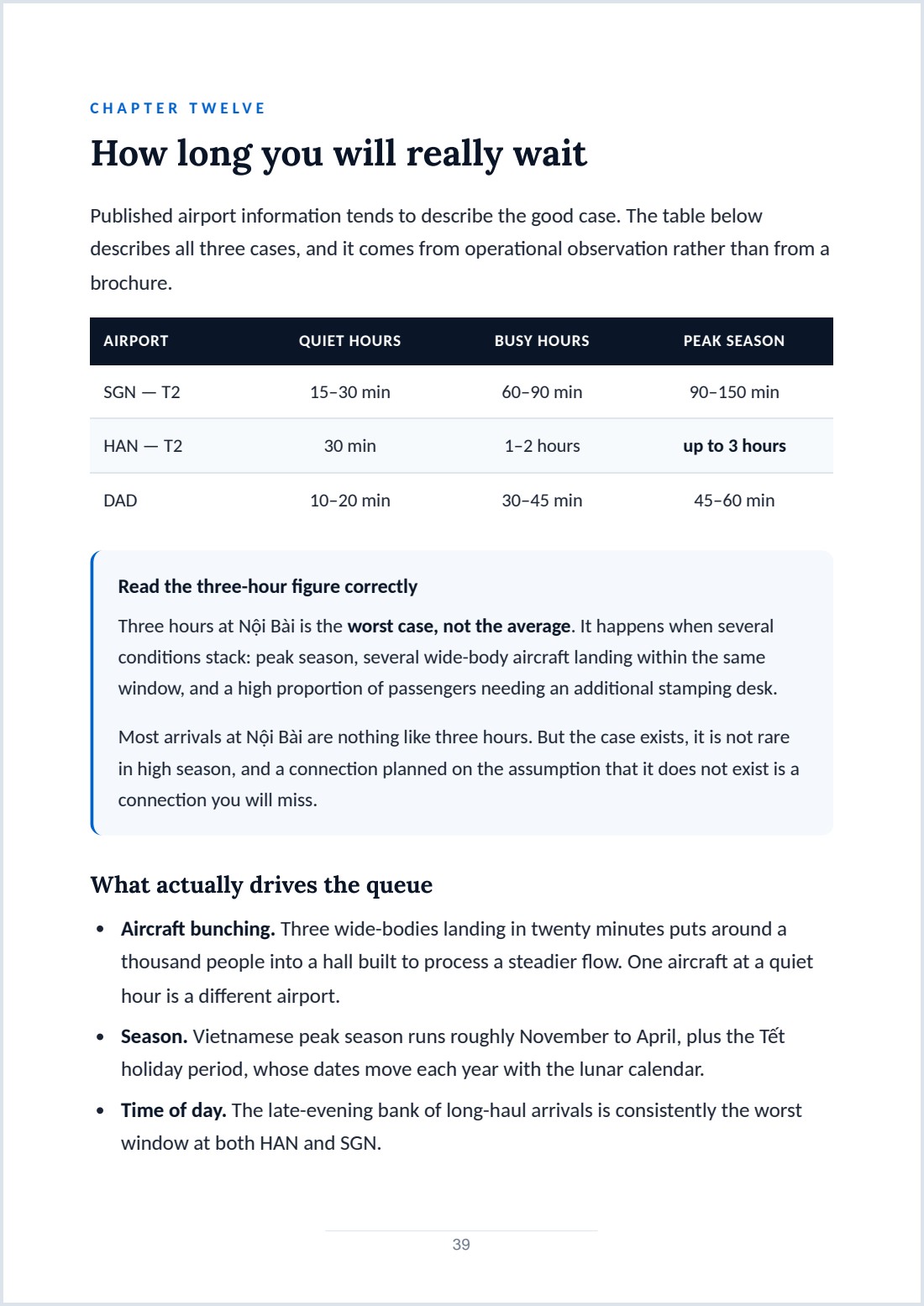
Immigration at Hanoi can take three hours in peak season, and international and domestic flights are in separate terminals. A three-hour layover is not the safe margin it looks like.
What is actually in it
Arranged in the order things happen to you — from considering the trip to walking out of the arrivals hall. Not by topic, and not written to be read cover to cover.
Do you even need a visa?
- The visa decision tree — 23 waiver countries, treaty countries, and the Bulgaria exception
- The six-month passport rule and its four traps
The e-visa, without the errors
- The e-visa step by step, and the date trap
- The six reasons applications get rejected
- Visa types, durations and residence cards
The chapters that save money
- The mandatory pre-arrival declaration
- What you may not bring — the absolute bans
- Duty-free allowances, cash and gold
- Power banks, liquids and cabin baggage
- The pre-flight checklist
What the queue really looks like
- Arrival, step by step
- Real waiting times by airport and hour
- Customs: green channel or red
- Fast track — the real prices, and when it is worth it
Staying out of trouble
- Registering where you stay — the 24-hour rule
- Money, ATM limits and exchange
- Overstaying: the full penalty schedule
Too narrow for a blog post
- Travelling with children
- Two passports, and passports reported lost
- Chinese E-series passports
- Phú Quốc and the island exception
The Document Pack
A book tells you what to do. These four sheets are what you actually hold at an airport. They download with the handbook, at no extra cost, and they are built to be printed on ordinary A4 paper and written on by hand.
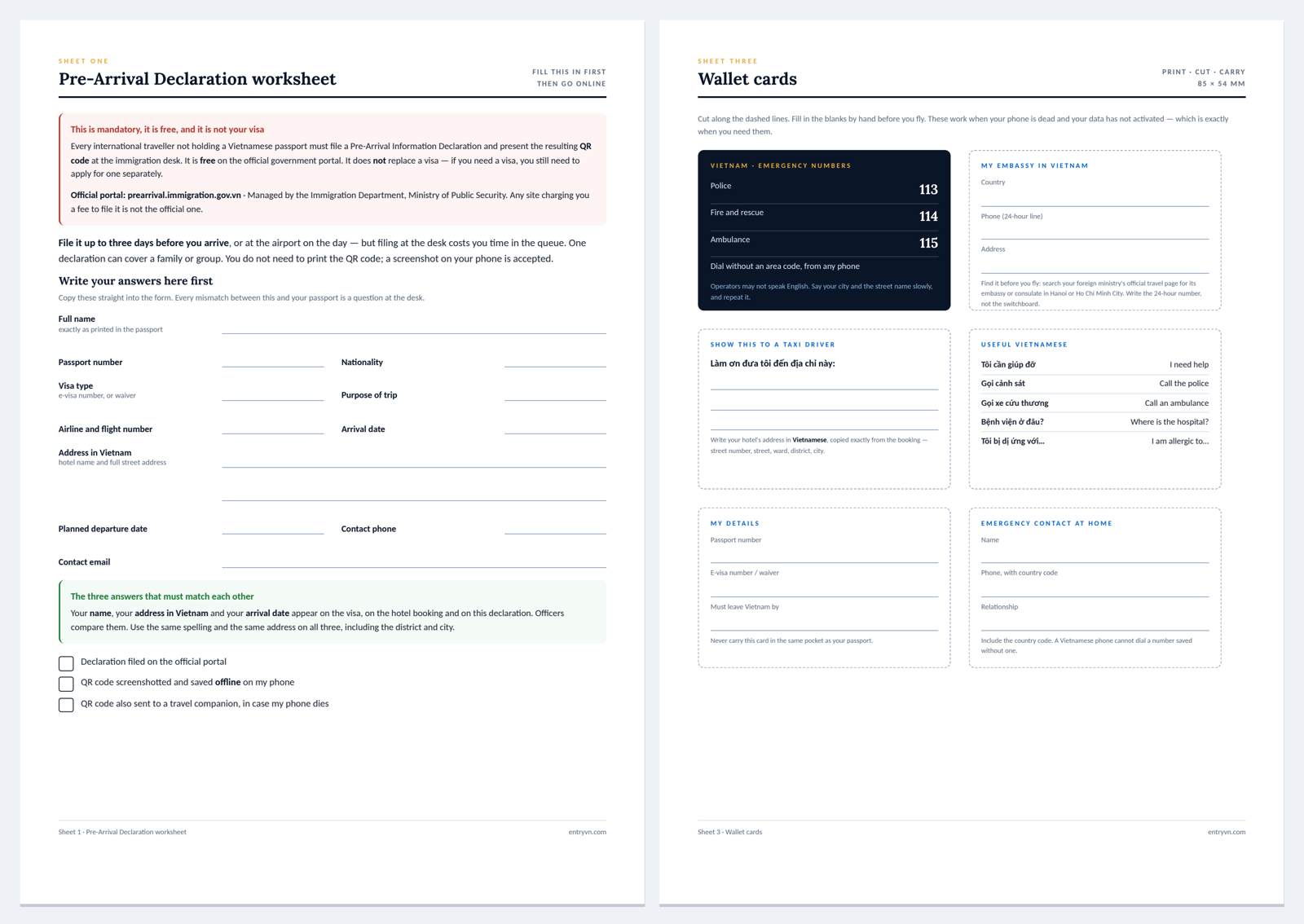
Pre-arrival declaration worksheet
Vietnam’s declaration is now mandatory at every major airport. Write every answer down first, then fill the government form once and correctly — and know which site is the free official one.
Pre-flight checklist
Documents, baggage, phone and money, with the duty-free allowances and declaration thresholds printed on the same page. Work through it the night before, bag open.
Wallet cards
Six cut-out cards: emergency numbers, your hotel address in Vietnamese to show a driver, essential phrases, your embassy, your own key details. Paper works when your phone is dead.
Stay tracker
Work out the exact date you must leave, from the stamp rather than the booking — next to the full overstay penalty schedule, so the cost of getting it wrong is in front of you.
Delivered as a second PDF in the same download. No extra charge, no upsell, no separate checkout.
The part you will not find online
Eight chapters carry a briefing called At the desk — what actually happens at a Vietnamese port of entry, written from working there rather than from reading about it. Here is one of them, in full.
This is the case where the traveller is most often entirely innocent and most often in the most serious trouble. Someone reports a passport lost while abroad, gets an emergency document, comes home, finds the original in a bag, and reasonably assumes it is still their passport.
It is not. Cancellation is a database event, not a physical one. The moment it was reported, it stopped being a travel document — and the border system knows that before the officer has finished opening it.
Look inside
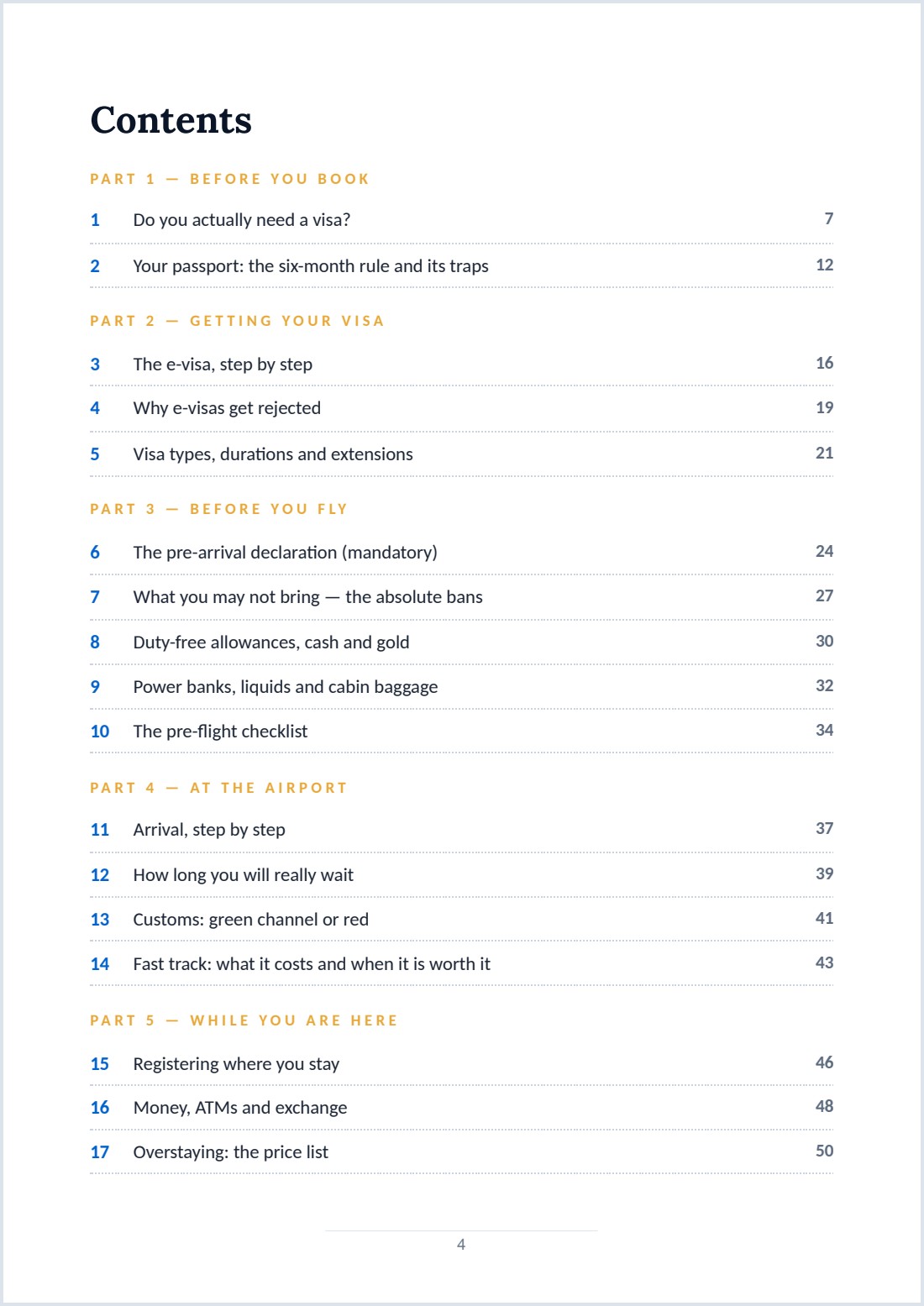
Three pages from the handbook, unretouched.
Honest about who this is for
It is a narrow book. That is the point — but it means it is wrong for some people, and we would rather say so now.
Buy it if
- It is your first trip to Vietnam and the paperwork is making you uneasy
- You are travelling with children, or with elderly parents
- You have a domestic connection on arrival day
- Your case is unusual — two passports, a previous refusal, a long stay
- You want one offline document instead of forty browser tabs
Don’t buy it if
- You want restaurant, hotel or itinerary recommendations — there is none of that here
- You have been to Vietnam several times and know the process
- You are happy reading our free articles and piecing it together yourself
- You are looking for a way around the rules rather than through them
Questions people ask
Isn’t most of this free on your blog?
A lot of the facts, yes — we publish more than a hundred free articles. The handbook is a different thing: it is ordered by the journey rather than by publication date, it works offline at the airport, it has decision trees a blog cannot do, and it covers the narrow cases that are too specific to write posts about. The eight “At the desk” briefings are not on the site at all.
What format is it?
Two PDFs. The handbook is 66 pages, sized for a phone screen and formatted to print cleanly. The Document Pack is four A4 sheets designed to be printed and written on. Both download immediately after payment. No app, no account, no expiry.
Vietnamese rules change. Will this go stale?
Yes, and we say so on the first page. Visa waivers run on government resolutions with fixed expiry dates, all of which are printed in the book alongside the rules. This edition is current as of 16 August 2026, and every rule carries its source so you can verify it yourself.
Is this legal advice?
No. It is a guide written from primary legal sources and direct operational experience. The immigration officer at the port of entry makes the decision, always.
How do I pay?
PayPal, or a debit or credit card, Apple Pay or Google Pay through the PayPal checkout — you do not need a PayPal account. Checkout asks for four things: your name, your email and your country. The download link is issued to your email as soon as payment clears.
Vietnam Entry Handbook 2026
66 pages on the only part of your trip where getting it wrong costs you the whole trip — plus the printable Document Pack, included free.
Get the handbook — $15