Vietnam Digital Nomad Visa Guide 2026: Best Options for Remote Workers
The Truth About Vietnam’s “Digital Nomad Visa”
As of July 2026, Vietnam does not offer a dedicated digital nomad visa. Countries like Indonesia (Bali), Portugal, Costa Rica, and Thailand (LTR visa) have introduced specific nomad/remote work visa categories. Vietnam has discussed similar options but has not yet implemented one.
This means remote workers in Vietnam in 2026 are using one of several existing visa categories — each with advantages and limitations:
Your Real Options as a Digital Nomad in Vietnam
Option 1: E-Visa (Tourist) — 90 Days
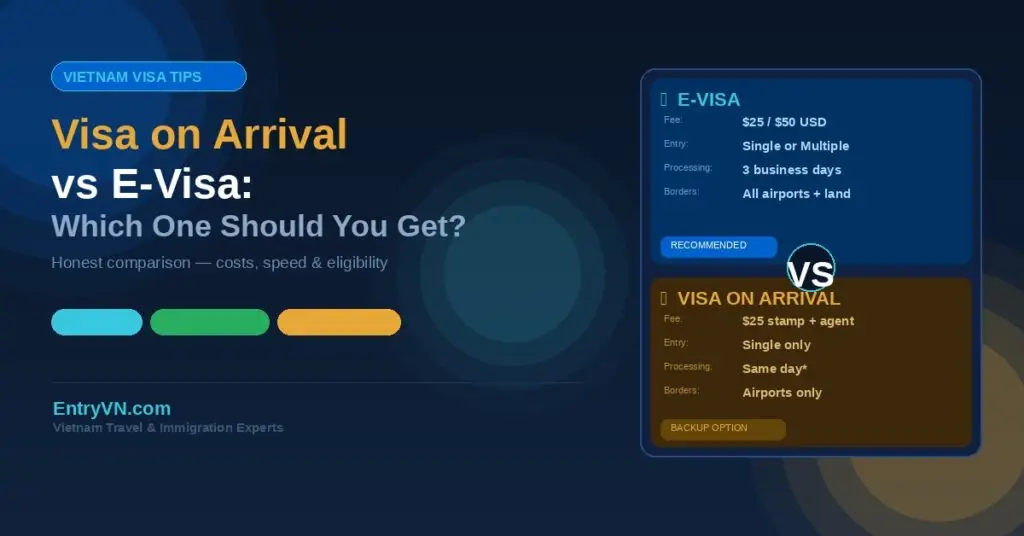
The e-visa (available at evisa.gov.vn) is the de facto “digital nomad visa” for Vietnam. It allows 90 days, is available to all nationalities, and costs $25 (single) or $50 (multiple entry). It cannot be extended — when it expires, you exit and apply for a new one.
The grey area: This is technically a tourist visa. Vietnamese immigration law does not explicitly prohibit working remotely for a foreign employer while in Vietnam on a tourist visa — but it also doesn’t explicitly permit it. In practice, the government has not been targeting remote workers on tourist visas. Many thousands of nomads have worked from Vietnam this way without issue.
What to avoid: Working for a Vietnamese company or client, signing Vietnamese contracts, or being paid in VND — these require a proper work permit. Remote work for a foreign employer, receiving payment to an overseas account, is a different situation.
Option 2: Business Visa (LV / DL categories) — Up to 12 months
Vietnam’s business visa categories (DL for tourism/business purposes; LV for business travelers) allow longer stays — up to 12 months with multiple entry, depending on the category and the applicant’s circumstances. These require more documentation including an invitation letter from a Vietnamese business or sponsor.
For nomads with Vietnamese business contacts or clients, a DL/LV visa is a more appropriate arrangement. You typically need to work with a Vietnamese company or consultant to obtain the supporting documents.
Option 3: Temporary Residence Card — Up to 2 Years
If you’re committing to Vietnam for 1–2 years, a Temporary Residence Card (Thẻ tạm trú) provides more stability than cycling e-visas. It requires a sponsoring entity (employer, investor, or family). Work permit (giấy phép lao động) holders can obtain the LĐ1 or LĐ2 card for 2 years. This is the appropriate path if you’re working for a Vietnamese company or setting up a business in Vietnam.
Option 4: Visa Run Strategy (for e-visa cycling)
Many nomads cycle 90-day e-visas — exit to Cambodia, Laos, or Thailand for a few days, then re-enter Vietnam with a fresh e-visa. Popular visa run destinations include: Phnom Penh (Cambodia, 2–3 hours from HCMC by bus), Vientiane (Laos, from Da Nang or Hanoi by bus/plane), and Chiang Rai/Bangkok (Thailand).
Caution: Immigration officers can question travelers who repeatedly enter on short-stay tourist visas. Vietnam immigration has discretion to deny entry to anyone they suspect is living permanently in Vietnam without appropriate authorization. This is rare in practice, but the risk increases with frequency of visa runs.
Best Vietnam Cities for Digital Nomads 2026
| City | Monthly Budget | Internet Speed | Nomad Vibe | Best For |
|---|---|---|---|---|
| Ho Chi Minh City (Saigon) | $800–1,500 | Excellent (fiber 300+ Mbps) | High-energy, huge expat scene | Business, networking, F&B |
| Da Nang | $700–1,200 | Excellent | Beach + city balance, growing | Work-life balance, beach access |
| Hoi An | $700–1,100 | Good (slower outside Da Nang) | Relaxed, creative, charming | Slow nomad, writers/creatives |
| Hanoi | $800–1,400 | Excellent | Cultural, historical, academic | Long-term explorers, culture lovers |
| Nha Trang | $600–1,000 | Good | Beach resort, Russian expat heavy | Beach lifestyle on tight budget |
Practical Setup: SIM Cards, Coworking, Accommodation
- SIM card: A 30-day carrier plan starts at $13, or $15 for genuinely unlimited data — arranged before you fly. Airport counters start at around $12 for the cheapest plan and mean a second queue after immigration. See our Vietnam SIM Card Guide for options including eSIM.
- Coworking spaces: Available in all major cities. Popular networks: Toong (HCMC, Hanoi), Enouvo (Da Nang), CoWorking Space Da Nang. Rates: $5–10/day, $80–150/month. Most offer stable fiber internet and air conditioning.
- Accommodation: Monthly rental of a furnished apartment is significantly cheaper than nightly hotel rates: $300–700/month for a 1-bedroom in Da Nang or Hanoi city center; $500–900 in HCMC D1/D3. Airbnb works but negotiating directly with local landlords via Facebook groups saves 30–40%.
- Banking: Keep a home-country account. Vietnam has no “foreigner-friendly” bank account for short-term visitors — most nomads use Wise, Revolut, or 28 Degrees for local withdrawals. ATM fees: 30,000–80,000 VND/transaction.
Arriving at Da Nang, Hanoi, or HCMC?
Fast Track at immigration means you start your nomad life faster — not stuck in a 90-minute queue.
Frequently Asked Questions
Vietnamese law doesn’t explicitly address remote work for foreign employers while on a tourist visa. The legal requirement is: you need a work permit (giấy phép lao động) to “work” in Vietnam — but the law targets working for Vietnamese entities and earning Vietnamese-source income. Working for a foreign employer, getting paid outside Vietnam, is a legal grey area that has not been prosecuted in practice. Most legal experts suggest this is tolerated but not officially permitted. The safest and clearest option remains obtaining a proper work permit through a Vietnamese employer or registered business entity.
Comfortable nomad lifestyle costs approximately $800–1,200/month in Da Nang or Hoi An, and $1,000–1,500/month in Hanoi or Ho Chi Minh City. This includes rent ($350–600 for a 1-bedroom), food ($200–350 mixing local and restaurants), coworking ($100–150), transport ($50–80 via Grab), and miscellaneous. Vietnam offers exceptional value for European and North American salary earners.
The Vietnamese government has discussed it but had not implemented one as of July 2026. Vietnam’s Ministry of Culture, Sports and Tourism has proposed a remote worker visa as part of post-pandemic tourism recovery plans. Given that neighbors like Thailand (LTR visa), Indonesia (E30G/B211A visa for remote workers), and Malaysia (DE Rantau visa) have all launched nomad visas, there is competitive pressure for Vietnam to follow. If introduced, we will update this article immediately. Check back or follow EntryVN for updates.
Technically yes — some banks (Vietcombank, Techcombank) will open accounts for foreigners with a valid visa and passport. In practice, it’s bureaucratically cumbersome: you often need proof of local income or employment, and account management in Vietnamese can be frustrating. Most nomads use Wise (for international transfers), a travel debit card for ATM withdrawals, and keep their primary finances offshore. This is workable for stays up to 90 days; for longer stays a local account becomes more useful.