Vietnam Visa on Arrival vs E-Visa: Which One Should You Get? (2026)
Planning a trip to Vietnam and confused about which visa to get? You’re not alone. Every day, thousands of travelers Google “Vietnam visa on arrival vs e-visa” — and come away more confused after reading contradictory advice.
Here’s the truth: for most travelers in 2026, the e-visa is the better choice. But visa on arrival still has a place in specific situations. This guide explains both options honestly, so you can make the right decision for your trip.
Quick Comparison: E-Visa vs Visa on Arrival
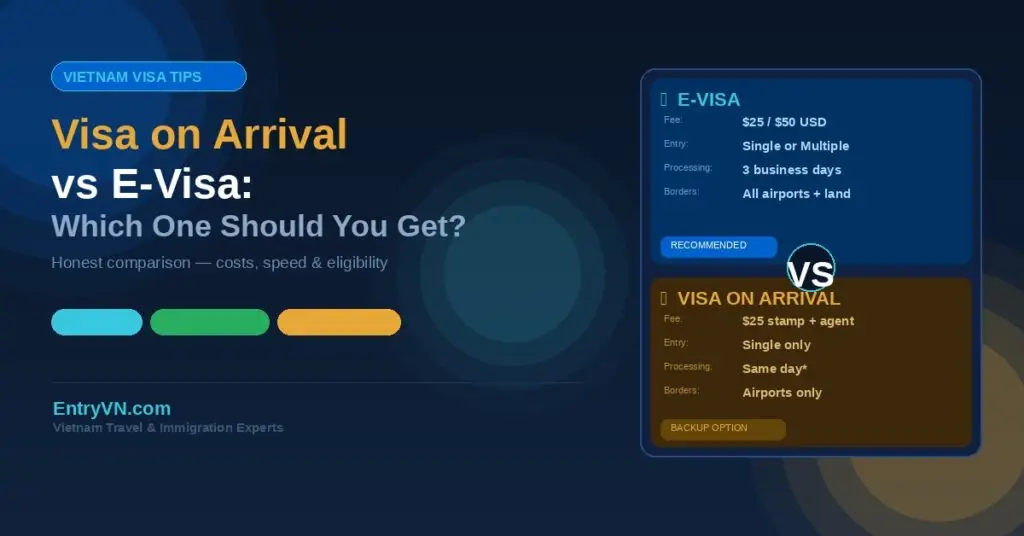
| Factor | 🔵 E-Visa | 🟡 Visa on Arrival | Winner |
|---|---|---|---|
| Official fee | $25 (single) / $50 (multiple) | $25 stamp fee + $15–50 agent fee | E-Visa |
| Where to apply | Online at evisa.gov.vn | Via agent online + stamp at airport | E-Visa |
| Eligible entry points | All airports + land borders + seaports | International airports only | E-Visa |
| Maximum stay | 90 days per entry | 90 days per entry | Tie |
| Processing time | 3 business days | Same day (approval letter in 1–2 days) | VOA |
| Airport queue | Normal immigration lane | Separate VOA counter (can be long) | E-Visa |
| Nationalities eligible | All 196 nationalities | Most nationalities (not all) | E-Visa |
| Single / Multiple entry | Both available | Single entry only (standard) | E-Visa |
| Apply on day of travel | No (need 3+ days in advance) | Yes (with pre-arranged approval letter) | VOA |
| Land / sea border entry | ✅ Yes | ❌ No | E-Visa |
| Risk of issues | Low (government portal) | Medium (depends on agent quality) | E-Visa |
What Is the Vietnam E-Visa?
The Vietnam e-visa is an official electronic visa issued by the Vietnamese government through its portal at evisa.gov.vn. It was expanded to all 196 nationalities in August 2023, replacing the previous whitelist system.
You apply entirely online, pay with a credit/debit card, and receive your visa as a PDF file via email. You print it (or show it digitally at some checkpoints) and present it when entering Vietnam. The process involves no embassy visit, no agent, and no additional fees beyond the government rate.
- Cost: $25 single entry / $50 multiple entry
- Valid for: Up to 90 days from the date of issue
- Processing: 3 business days on average
- Entry points: All international airports, major land borders, sea ports
What Is Vietnam Visa on Arrival?
Despite the name, visa on arrival is not obtained at the airport — it must be pre-arranged. Here’s how it actually works:
Apply online via a licensed agent
You submit your passport details to a Vietnam visa agent (not a government portal). The agent obtains an official approval letter from the Vietnam Immigration Department on your behalf — this takes 1–3 business days.
Receive approval letter by email
The agent sends you a PDF approval letter. You must print this letter and bring it to the airport. Without the printed letter, you cannot proceed to the VOA counter.
Arrive at a Vietnamese international airport
Note: VOA is only available at international airports. If you’re entering by land (from Cambodia, Laos, or China) or by sea, VOA is not an option.
Queue at the VOA counter
Go to the “Landing Visa” or “Visa on Arrival” counter inside the airport. Submit your approval letter, passport, passport photo, and pay the $25 stamping fee in cash (USD preferred, no card payment accepted).
Wait and receive your visa stamp
Processing at the VOA counter typically takes 20–45 minutes. During peak hours (multiple international flights arriving together), it can take over an hour. Your visa stamp is then placed in your passport.
Pros and Cons: Side by Side
🔵 E-Visa — Pros & Cons
- ✅ Cheapest option ($25 or $50)
- ✅ No agent needed — apply directly
- ✅ Valid at all entry points (airports, land, sea)
- ✅ Multiple entry available
- ✅ No airport queue for stamping
- ✅ Pre-cleared before travel = peace of mind
- ✅ All nationalities eligible
- ❌ Needs 3+ business days to process
- ❌ Cannot apply day-of or last minute
- ❌ Portal can be confusing for first-timers
🟡 Visa on Arrival — Pros & Cons
- ✅ Faster in urgent situations (1–2 day approval letter)
- ✅ Useful if e-visa was rejected
- ✅ Agent handles most of the paperwork
- ❌ More expensive ($25 stamp + $15–50 agent fee)
- ❌ Only at international airports
- ❌ Long queue at VOA counter on arrival
- ❌ Must carry printed approval letter
- ❌ Must pay $25 in cash at airport
- ❌ Single entry only (standard)
- ❌ Quality depends on agent chosen
When to Choose Each Option
The right choice depends on your specific situation. Here are the most common scenarios:
✈️ Planning trip 1+ week in advance
You have enough time for standard e-visa processing (3 business days).
→ E-Visa🗺️ Entering via land border (Cambodia, Laos, China)
VOA is not available at land crossings. E-visa is your only online option.
→ E-Visa🔄 Visiting multiple times or staying long-term
Multiple-entry e-visa ($50) is far cheaper than multiple VOA applications.
→ E-Visa⚡ Flight in 2–3 days, no time for e-visa
E-visa takes 3 business days. VOA approval letter can be arranged in 24 hours.
→ VOA🚫 E-visa was rejected
If your e-visa was denied for a fixable reason, VOA via a trusted agent is a reliable backup — agents can advise on eligibility before submission.
→ VOA💼 Business travel with flexible plans
Multiple-entry e-visa gives freedom to enter and exit multiple times without reapplying.
→ E-VisaReal Cost Comparison
Let’s break down what each option actually costs for a single traveler entering by air:
| Cost Item | 🔵 E-Visa | 🟡 Visa on Arrival |
|---|---|---|
| Government / official fee | $25 | $25 (stamp at airport) |
| Agent service fee | $0 (apply yourself) | $15–$50 (required) |
| Passport photos | $0 (digital upload) | $0–$5 (physical at airport) |
| Fast Track add-on (optional) | $22 | $22 |
| Total (budget) | $25 | $40–$70+ |
Over a year of frequent travel, this difference compounds significantly. For families of 4, the e-visa saves $60–$180 per trip.
🛂 Not Sure Which Option Is Right for You?
Tell us your situation — EntryVN’s team will recommend the best visa type and handle the application for you.
Our Recommendation
For Most Travelers: Choose the E-Visa
If you’re planning your trip at least 5 days in advance and entering through any major airport or land border, the e-visa is cheaper, simpler, and safer. Apply directly at evisa.gov.vn — no agent, no extra fees, no airport queues.
Apply for E-Visa →Choose Visa on Arrival only if: your trip is in fewer than 3 business days, your e-visa was previously rejected, or you need an agent to guide you through the process. In those cases, use a trusted, licensed agent — and budget for the extra cost.
🛂 Let Us Handle the Visa
E-visa done for you, all in, with the pre-arrival declaration filed free. Confirmation within 24 hours.
See Visa Service →Frequently Asked Questions
Yes — if your e-visa processing is taking longer than expected, you can arrange a VOA approval letter in parallel. However, once an e-visa is approved and you enter Vietnam with it, you cannot simultaneously use VOA. Choose one and proceed with it.
Yes — VOA is available at all Vietnamese international airports, including Da Nang (DAD), Cam Ranh/Nha Trang (CXR), and Phu Quoc (PQC), not just Hanoi and Ho Chi Minh City. However, the VOA counter at smaller airports may have limited operating hours — confirm with your agent before traveling.
Use the nationality printed in the passport you are traveling with. If you hold dual nationality and carry two passports, use whichever passport you plan to enter Vietnam with. Your visa will be tied to that passport number.
If you remain in the international transit zone and do not pass through immigration, most nationalities do not need a visa. However, if you want to exit the airport and explore the city during a layover, you will need a valid Vietnam visa or qualify for a visa exemption.
Visa extensions inside Vietnam are possible but require visiting an immigration office and can be complex. It is generally easier to plan your trip duration in advance and apply for a 90-day visa from the start rather than trying to extend a shorter one.