Vietnam Business Visa 2026: Cost, Requirements & How to Apply
What Is a Vietnam Business Visa?
Vietnam does not have a separate “business visa” category for most foreign nationals. For short-term business travel — attending meetings, signing contracts, visiting clients, conducting market research, or attending conferences — the standard Vietnam e-visa (EV) is the correct document. It covers both tourism and business purposes and is accepted at all international airports, border gates, and seaports.
The confusion around “business visa” usually arises because travelers assume there must be a separate category for professional visits. In practice, Vietnamese immigration authorities accept the e-visa for virtually all legitimate short-term business activities. You do not need to specify “business” versus “tourism” when applying — both purposes fall under the same e-visa framework.
Longer-term arrangements — where a foreign national will work in Vietnam, receive a Vietnamese salary, or be employed by a Vietnamese company — require a work permit (giấy phép lao động) and a corresponding temporary residence card. This is a separate process arranged by the employing company, not the individual traveler.
Vietnam Business Visa Fee 2026
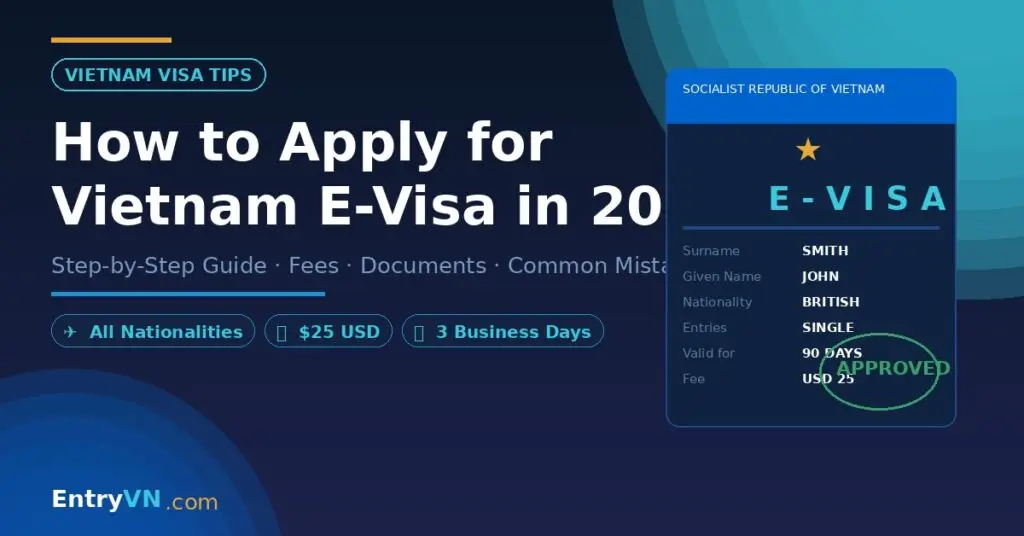
The fee for a Vietnam e-visa (the standard document for business travelers) is set by the Vietnamese government and applies uniformly regardless of nationality:
| Visa Type | Fee (USD) | Validity | Entries |
|---|---|---|---|
| E-Visa — Single Entry | $25 | Up to 90 days | 1 entry |
| E-Visa — Multiple Entry | $50 | Up to 90 days | Unlimited entries |
These fees are paid online at evisa.gov.vn during the application process. Third-party visa agencies typically charge an additional service fee on top of the government fee — using the official government portal directly avoids this surcharge.
Requirements for a Vietnam Business Visa
The e-visa requirements are the same whether you’re visiting for tourism or business:
- Valid passport with at least 6 months’ validity remaining from your planned entry date
- Passport-style photo (digital, white background, clear face, taken within the last 6 months)
- Photo of the passport biographical page (the page with your photo and personal details)
- Planned entry and exit dates (exact dates required — you must enter on or before the e-visa’s start date)
- Intended entry point (airport, land border, or seaport — all major international airports qualify)
- Accommodation address in Vietnam (hotel or business address is fine)
- Payment method for the application fee (credit/debit card accepted)
No invitation letter, business registration documents, or employer letters are required for the standard e-visa — this is one of its key advantages over some other countries’ business visa systems. The Vietnamese government simplified the e-visa framework in 2023 specifically to make it accessible to all nationalities without extra bureaucracy.
How to Apply: Step by Step
Go to evisa.gov.vn
Navigate to the official Vietnam e-visa portal. Select “Apply E-Visa” and choose your nationality from the dropdown.
Fill in your personal details
Enter your passport information exactly as it appears on your passport. Upload the required photos (passport biographical page + portrait photo).
Set your travel dates and entry point
Enter your planned entry date and exit date (up to 90 days apart). Select your entry airport — Noi Bai (Hanoi), Tan Son Nhat (HCMC), Da Nang, or whichever gateway you’ll be using. For business travel with flexible schedules, apply 1–2 weeks before your first possible entry date.
Choose single or multiple entry and pay
Select single ($25) or multiple ($50) entry. Pay by credit or debit card. Keep your application reference number — you’ll use it to check approval status.
Wait for approval and download
Standard processing: 3–5 business days. Rush options are available: 1–3 business days (higher fee) or urgent 2–8 hours (highest fee). Download and print your approved e-visa — airlines and immigration officers expect to see a printed copy.
Need help with your business visa application?
EntryVN handles e-visa applications and can flag any issues before they cause problems at the border.
E-Visa vs Visa on Arrival for Business Travel
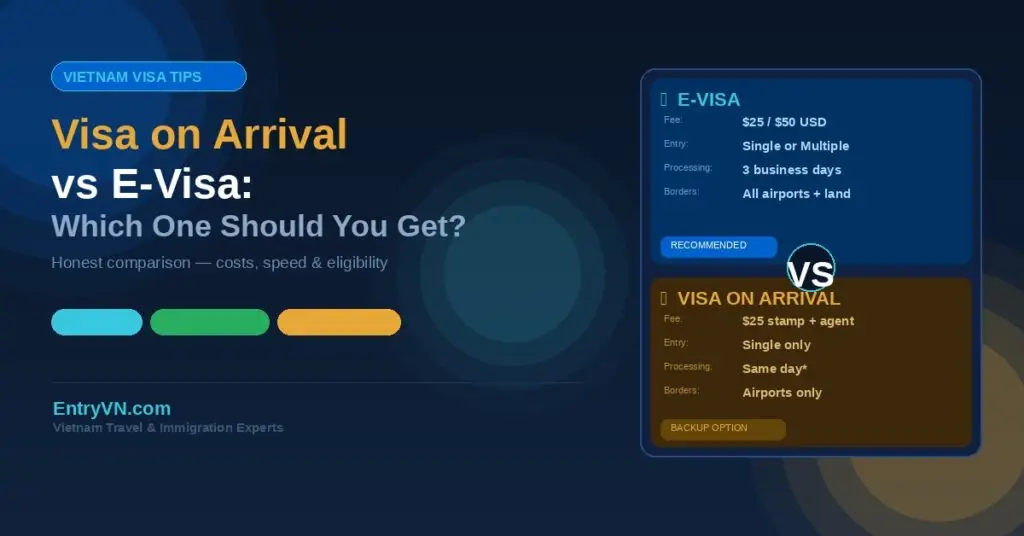
Vietnam’s e-visa has largely replaced visa on arrival (VOA) as the preferred entry method for business travelers since 2023. Here’s how they compare:
| E-Visa | Visa on Arrival | |
|---|---|---|
| Who can use it | All nationalities | Requires prior approval letter from sponsor |
| Where to apply | evisa.gov.vn (online) | Via a Vietnam-based agency or employer |
| Processing time | 3–5 business days | 1–3 business days (approval letter) |
| Fee | $25/$50 (government) | $25–$50 approval + $25–$50 stamping fee at airport |
| Airport queue | Standard immigration lane | Separate stamping counter (slower, extra step) |
| Recommended | ✅ Yes — simpler, cheaper, faster arrival | Only if e-visa is unavailable for your nationality |
Since Vietnam opened the e-visa to all nationalities in August 2023, there is very little reason to use visa on arrival for business trips. The e-visa is simpler to arrange, costs the same or less overall, and results in a faster airport experience because you skip the dedicated VOA stamping counter.
Long-Term Business Stays: Work Permits and Residence
If your business activities in Vietnam extend beyond short-term visits — particularly if you will be employed by or seconded to a Vietnamese company — the e-visa is not the right long-term solution. Here’s how longer-term arrangements work:
Work Permit (Giấy phép lao động)
Foreign nationals working in Vietnam (receiving a Vietnamese salary, employed under a Vietnamese labor contract, or managing a Vietnamese entity) must obtain a work permit. Work permits are arranged by the employing company, not the individual, and require documentation including qualifications, health certificates, and a criminal record check. Once approved, the work permit enables application for a temporary residence card (thẻ tạm trú), which replaces the need for a separate visa.
Business Investor Visa Options
Foreign investors and business owners in Vietnam may be eligible for longer-stay options under the investment visa categories (ĐT visa class), which can provide residence of 2–10 years depending on investment scale. These are arranged through the relevant investment authority (Department of Planning and Investment) and require formal investment registration in Vietnam.
Practical Tips for Business Travelers
- Apply multiple entry if your trip involves any regional travel — crossing into Cambodia, Laos, or Thailand and returning counts as a new entry.
- Apply at least 7 business days before departure to have buffer for any processing delays. Rush processing is available but costs more.
- Print your e-visa — airlines at check-in and immigration officers on arrival expect to see a physical copy, not just a phone screen.
- Dates are strict — your e-visa is only valid from the start date you specified on the application. Arriving before that date is not permitted. If your travel dates change after approval, you must apply for a new e-visa.
- Fast Track on arrival — for business travelers arriving on tight schedules, airport Fast Track (available at Noi Bai, Tan Son Nhat, and Da Nang) can cut immigration wait times significantly during peak periods.
Frequently Asked Questions
The Vietnam business visa fee is $25 USD for single entry or $50 USD for multiple entry. These are the official government fees paid directly on evisa.gov.vn. Third-party agencies charge additional service fees on top of this. The e-visa is valid for up to 90 days from the approved start date.
There is no separate “business visa” category for most short-term business visits. The standard Vietnam e-visa covers both tourism and business purposes. You do not need to declare a “business” purpose separately on the application — the e-visa is accepted for attending meetings, visiting clients, signing contracts, and other short-term business activities.
The e-visa is valid for up to 90 days from the start date you specify on the application. For multiple entry visas, you can exit and re-enter Vietnam as many times as you like within those 90 days. The e-visa cannot be extended — if you need to stay longer, you must exit Vietnam and reapply for a new e-visa.
No. The Vietnam e-visa does not require an invitation letter, sponsorship, or employer documentation for short-term business travel. This is one of the key differences from some other countries’ business visa systems. You apply directly at evisa.gov.vn with only your passport and photo.
No. The e-visa permits short-term business activities (meetings, site visits, negotiations) but does not authorize employment in Vietnam. If you will be employed by a Vietnamese company, receive a Vietnamese salary, or be assigned to Vietnam by your employer for an extended period, you need a work permit (giấy phép lao động) arranged by the employing company.
Apply online at evisa.gov.vn. The process takes about 15 minutes: fill in your personal and passport details, upload a passport photo and photo of your biographical page, enter your travel dates and entry point, choose single ($25) or multiple ($50) entry, and pay by card. Approval takes 3–5 business days under standard processing, or 2–8 hours for urgent processing.
The e-visa cannot be extended beyond 90 days. If your business activities in Vietnam will exceed 90 days, you should explore whether a work permit and temporary residence card is required for your situation — particularly if you will be employed by or seconded to a Vietnamese entity. Consult an immigration specialist for long-term arrangements, as these depend heavily on your specific employment structure.