Vietnam Entry Checklist: Every Document, in the Order You Need It
Most entry problems aren’t caused by not knowing a rule. They’re caused by finding out about it too late to act — a passport that expires five months after your trip, an e-visa applied for two days before the flight, a bottle in your bag you can’t take. Every one of those is easy at the right moment and painful at the wrong one.
Here’s the whole sequence on one page. Scan the table, then read the step you’re currently at.
| When | What to do | Why the timing |
|---|---|---|
| 60 days before | Check passport expiry | Renewals take weeks; this is the only step that can’t be rushed |
| 30 days before | Find out if you need a visa | Determines whether the next step exists at all |
| 7–14 days before | Apply for the e-visa | Processing runs 3–5 business days, and rejections need a second attempt |
| 3 days before | Submit the pre-arrival form | The system won’t accept it earlier than this |
| While packing | Check what you can bring | Easier to leave something at home than to have it taken |
| Flight day | Prepare for immigration | Everything you need should be in hand before you queue |
The Six Steps
Check your passport expiry date
The rule depends on how you enter. Visa-free: your passport needs at least six months of validity from your arrival date — five months feels like plenty, but it isn’t. With an e-visa: your passport must stay valid at least 30 days beyond the end date of the visa.
Do this first because it’s the only item on this list you can’t fix in a hurry. Everything else takes days; a passport renewal takes weeks.
Full guide: Vietnam passport validity rules →Find out whether you need a visa at all
Twenty-three nationalities enter Vietnam visa-free for 45 days, and a further group has bilateral agreements ranging from 14 to 90 days. If you’re on either list, you can skip the next step entirely — no application, no fee.
Check now rather than later, because the answer changes what the following two weeks look like. Note that these exemptions run on government resolutions with expiry dates, so a list you read last year may be out of date.
Full guide: all 23 visa-free countries →Not sure which of these applies to you?
Send us your nationality and travel dates on WhatsApp. We’ll tell you exactly which steps on this list you need and which you can skip — no charge for the question.
Apply for the e-visa, if you need one
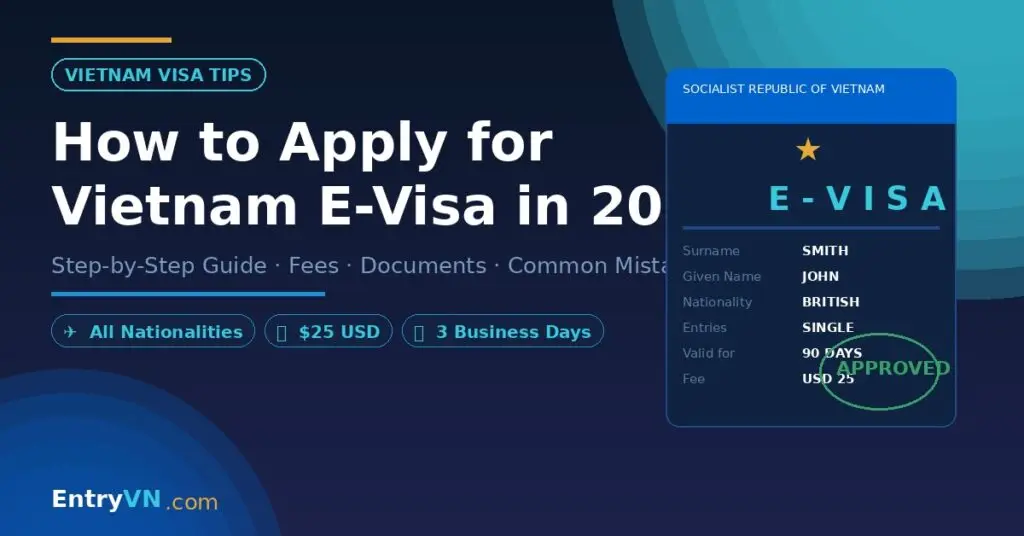
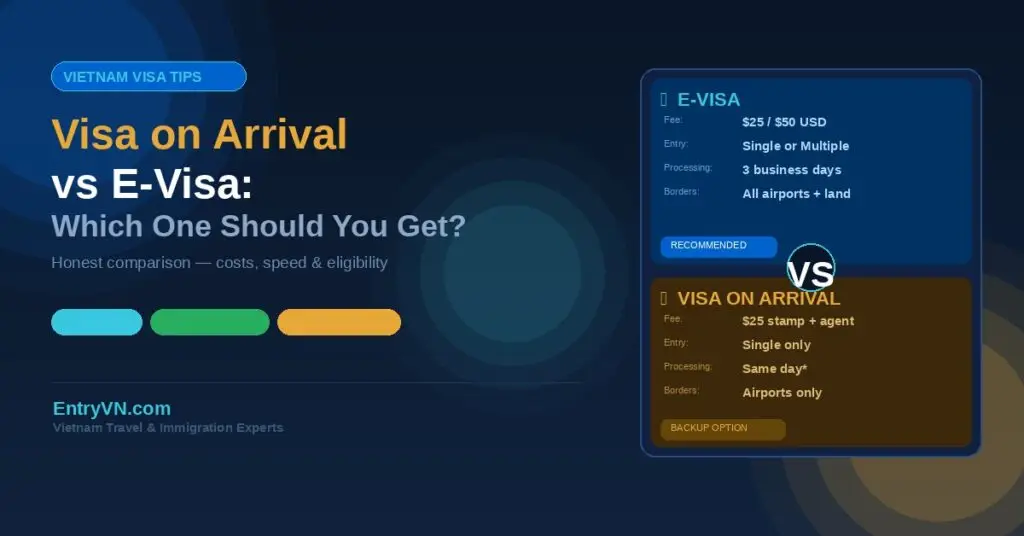
The e-visa costs USD 25 for single entry or USD 50 for multiple entry, is valid up to 90 days, and is applied for online at evisa.gov.vn — the only official portal. Standard processing takes 3–5 business days.
The reason for applying two weeks out rather than three days out is the rejection case. Applications get refused for photo problems or mismatched details, and if that happens you want time for a second attempt rather than a cancelled trip.
Full guide: e-visa application, step by step →Submit the pre-arrival declaration
Every foreign passenger arriving at a Vietnamese international airport must complete this free online declaration, regardless of nationality or visa status. It produces a QR code you show at immigration, and it takes about five minutes at prearrival.immigration.gov.vn.
Three days is the earliest the system accepts it — this is the one step you can’t do in advance. Set a reminder, because it’s also the one most likely to be forgotten in the rush before departure.
Full guide: the pre-arrival form, field by field →Check what you can and can’t bring
The limits worth knowing before your case is full: 1.5 litres of spirits, 200 cigarettes, cash above USD 5,000 must be declared, and gold above 300 grams too. Power banks go in your cabin bag, never checked, maximum two.
One item catches more travellers than all of those combined: vapes and heated tobacco are banned outright in Vietnam and confiscated at the border, with no exemption for personal use. If you vape, deal with that now rather than at the X-ray.
Full guide: Vietnam customs rules →Get through immigration
Have four things reachable without unpacking: passport, visa or e-visa printout, the pre-arrival QR code screenshotted so it works offline, and your hotel address written down. The officer will ask for the address, and hunting through a booking app in the queue wastes everyone’s time.
Budget realistically. Immigration at Noi Bai runs about 30 minutes off-peak but reaches three hours in peak season, and visa on arrival is the slowest route of all because of the extra stamping counter.
Full guide: what to expect at immigration →What You Can Skip
Not every step applies to everyone, and a shorter list is easier to finish:
| If you are… | Skip | Still required |
|---|---|---|
| From a visa-free country, staying under 45 days | The e-visa step entirely | Everything else |
| Flying direct to Phu Quoc | The visa step — 30 days visa-free for all nationalities | Everything else |
| Already holding a valid multiple-entry visa | The e-visa step | Everything else |
| Transiting airside without entering Vietnam | Visa and customs steps | Nothing — you’re not entering |
Fees, allowances and exemption lists in this checklist are drawn from Vietnam’s current immigration and customs framework and are accurate as of 16 August 2026. Exemption lists run on time-limited government resolutions — verify at evisa.gov.vn before booking if your travel is far ahead.