Vietnam E-Visa for Indian Nationals 2026: Complete Guide
Vietnam Visa Requirements for Indian Passport Holders
| Detail | Information |
|---|---|
| Visa required? | Yes — Indian passport holders require a Vietnam visa |
| Best option in 2026 | Vietnam E-Visa at evisa.gov.vn |
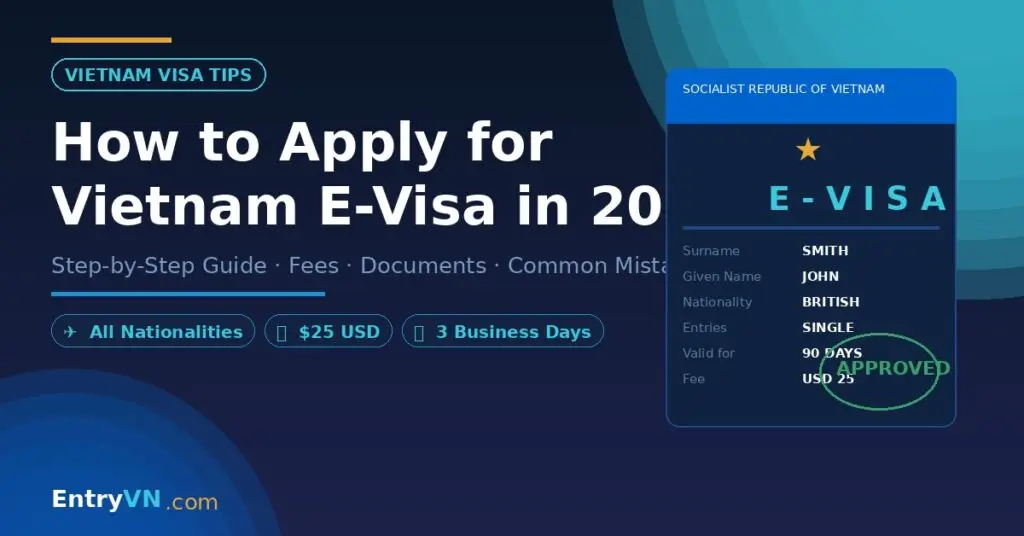
| Cost | $25 (single entry) | $50 (multiple entry) |
| Maximum stay per visa | 90 days |
| Extendable? | No — must exit and reapply |
| Processing time | 3–5 business days (standard) |
| Entry ports | All international airports, major land borders, seaports |
| Passport validity needed | At least 30 days beyond the end date of the visa — not 6 months from departure from Vietnam |
How to Apply: Step-by-Step for Indians
Visit evisa.gov.vn (the official portal only)
Select “Apply for E-Visa.” The government fee is $25 (single) or $50 (multiple entry). Beware of unofficial third-party sites charging $50–100+ for the same service — they act as middlemen but you’re paying double. The official site accepts Visa, Mastercard, and international debit cards.
Enter personal details exactly as in passport
Full name (as per passport), date of birth, nationality, passport number, issue/expiry dates, place of issue. Also needed: planned entry date, exit date, purpose of visit (tourism), port of entry (e.g., Tan Son Nhat / Noi Bai), accommodation in Vietnam.
Upload documents
Two images required: (1) scanned/photographed biographical page of your passport; (2) recent passport-style photo (white or light background, face fully visible, no spectacles if possible). Both should be sharp and well-lit.
Pay and submit
Review all details carefully before payment — errors after submission require contacting support to correct. Once paid, you receive a reference number to track your application status on evisa.gov.vn.
Receive your e-visa (3–5 business days)
The approved e-visa arrives as a PDF by email. Print it or save it clearly on your phone. The immigration officer will physically review and stamp it — you need to present it at the airport.
Complete Vietnam Pre-Arrival Declaration
Before boarding your flight, complete the free pre-arrival declaration at prearrival.immigration.gov.vn. This generates a QR code to show immigration officers on arrival. Required for all international visitors as of 2026.
Tips Specific to Indian Travelers
- Indian passport format: Indian passports issued after 2013 are machine-readable with a chip. The biographical page scan must be clear — darker Indian passport colors can sometimes create contrast issues. Scan under good lighting or use the “document mode” on your phone camera.
- Popular Indian entry points: Most Indian travelers fly into Noi Bai (HAN) for North Vietnam or Tan Son Nhat (SGN) for South Vietnam. Direct flights are available from Delhi, Mumbai, Bangalore, Chennai, and Hyderabad.
- Flight connections: Many Indian carriers (IndiGo, Air India, Vistara) operate direct Vietnam routes. Budget connection via Kuala Lumpur (AirAsia) or Singapore (Scoot) are popular options.
- Currency: Vietnam uses Vietnamese Dong (VND). There are no direct INR–VND exchange counters at most places. Change to USD before departing India, then exchange to VND on arrival. Airport exchange rates are 2–4% worse than city rates.
- Apply early: Apply at least 10 days before your travel date. Festival periods (Diwali, Christmas/New Year) see processing backlogs.
Flying into Da Nang, Hanoi, or Ho Chi Minh City?
Pre-book Fast Track to skip the immigration queue — recommended for families and peak season arrivals.
Frequently Asked Questions
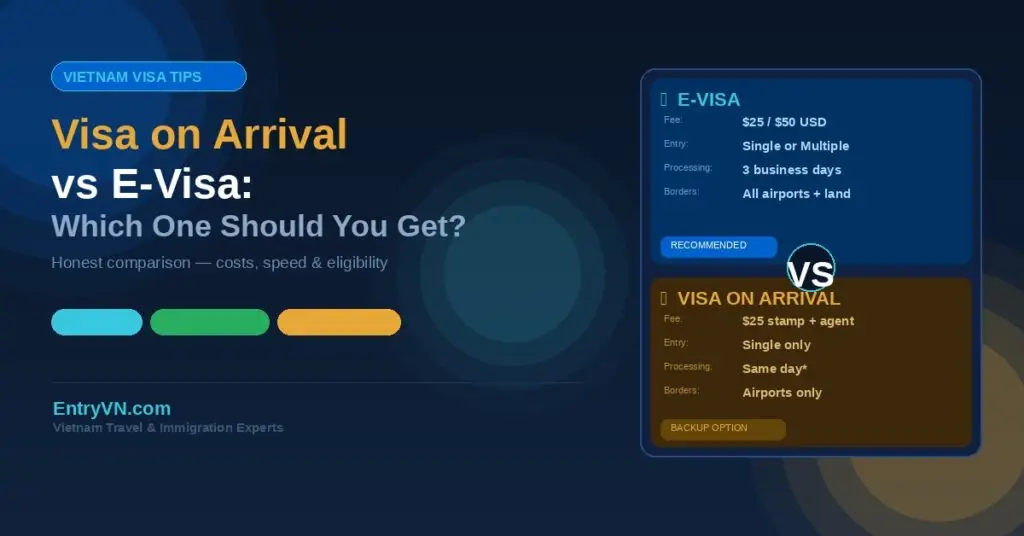
Yes, Visa on Arrival (VOA) is technically available for Indians — it requires obtaining an approval letter in advance from a Vietnamese travel agency, then paying a stamping fee ($25) on arrival. However, the e-visa ($25 total, fully online at evisa.gov.vn) is cheaper, more reliable, and doesn’t require trusting a third-party agency. The e-visa is the clear recommended option for Indians in 2026.
Extremely popular and generally well-suited to Indian travelers. Vietnam is vegetarian-friendly in many areas (Buddhist traditions mean plenty of plant-based options), reasonably affordable, and has a vibrant street food culture. Hoi An, Ha Long Bay, Da Nang, and Ho Chi Minh City are the top picks for Indian visitors. Phu Quoc is increasingly popular as a beach resort alternative to Maldives/Bali.
For legitimate tourist visits, approval rates for Indian nationals are high. The most common rejection reasons are photo quality issues (blurry, incorrect background), data mismatches vs. the passport, or an incorrectly specified entry date. There are no reports of systematic issues for Indians applying through the official evisa.gov.vn portal.
For a mid-range trip (decent hotels, mix of restaurants, tours), budget $80–120 per person per day. A 10-day Vietnam trip would cost roughly $800–1,200 per person excluding flights. Cash (USD) is useful to have for smaller places and markets; Grab (app) for all rides in cities. ATMs are widely available in all tourist areas.