Vietnam Visa on Arrival 2026: The Complete Guide (And Why E-Visa Is Usually Better)
What Is Vietnam Visa on Arrival?
Vietnam Visa on Arrival (VOA) is a system where you obtain pre-approval from a Vietnamese immigration authority (through an authorized agent) before you travel, then collect the actual visa stamp at the immigration counter when you land at a Vietnamese international airport.
Despite the name, “visa on arrival” isn’t something you can get spontaneously when you show up. You must arrange the approval letter in advance — typically 1–3 business days before your flight. The “on arrival” part simply refers to where the physical stamp is applied.
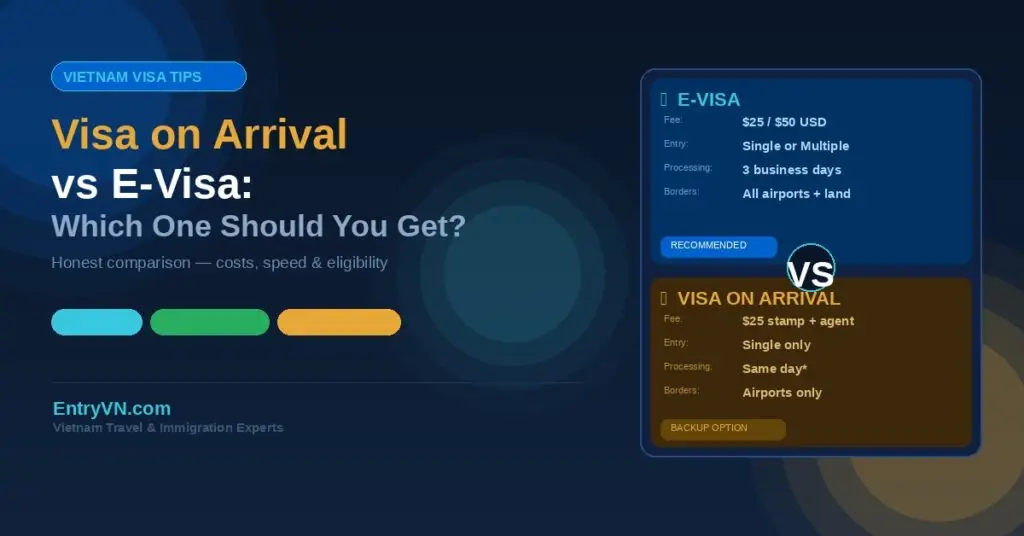
VOA vs E-Visa: Full Comparison
- ✅ Works for most nationalities
- ✅ Can be organized quickly (1–3 days)
- ⚠️ Requires approved letter from agent ($15–25)
- ⚠️ Pay stamping fee at airport separately
- ⚠️ Airport-only entry (no land/sea borders)
- ⚠️ Queue at VOA desk on arrival
- ❌ More complex, more steps
- ❌ Can cause issues if approval letter has errors
- ✅ All nationalities eligible
- ✅ Single entry $25 / Multiple entry $50
- ✅ Apply directly at evisa.gov.vn
- ✅ Valid for ALL entry points (airports, land, sea)
- ✅ Up to 90 days per visit
- ✅ No extra fees at the airport
- ✅ Simpler: one payment, one process
- ⚠️ 3–5 business days processing (plan ahead)
How Vietnam Visa on Arrival Works: Step by Step
If you’ve decided VOA is the right option for you, here’s the complete process:
Find a Licensed Agent and Submit Your Application
You need a Vietnamese company (travel agency or visa agent) to submit your application to the Vietnam Immigration Department on your behalf. Provide: full name as on passport, passport number, nationality, date of birth, purpose of visit, intended entry and exit dates.
Receive and Print Your Approval Letter
Your agent emails you the approval letter (also called Letter of Approval or Letter of Introduction). Print it — a digital copy on your phone may be rejected at some airports. The letter lists the approved arrival date window and your visa type.
Arrive at a Vietnamese International Airport
VOA only works at international airports. On landing, follow signs for “Visa on Arrival” or “Landing Visa” — there’s typically a separate desk before the main immigration counters. Have your printed approval letter, passport, photos, and stamping fee ready.
Complete the Arrival Form and Pay Stamping Fee
Submit your approval letter, passport, two passport-size photos (4×6cm, white background), and pay the stamping fee in cash. Stamping fees vary by visa type and duration — typically in the range of $25–50 USD or equivalent in VND. Fees may change; confirm current amounts before travel.
Collect Your Visa and Proceed to Immigration
Staff at the VOA desk process your stamp (typically 10–20 minutes, can be longer during busy periods). You then join the regular immigration queue with your new visa stamp in your passport.
Need a Vietnam Visa? We handle it.
E-visa application, VOA approval letters, and fast track — handled remotely with 24h confirmation.
VOA Approval Letter: What to Watch Out For
The approval letter is the critical document for VOA. Errors in the approval letter can lead to problems at immigration. Key things to check before you travel:
- Your full name exactly as in your passport (including middle names and exact spelling)
- Passport number — must be exact
- Date of birth
- Arrival date window — your flight must land within the approved period
- Entry point — must match the airport you’re arriving at
- Visa type and duration requested
Who Should Still Use VOA?
With e-visa now available to all nationalities, VOA usage has declined significantly. But there are still situations where VOA makes sense:
- Very last-minute travel (under 24 hours): Some VOA agents can process in hours; e-visa requires at least 1 business day (emergency processing available).
- E-visa technical issues: If evisa.gov.vn is experiencing problems and you can’t complete the application.
- Travelers who prefer agent-assisted processes: Some travelers prefer having an agent handle paperwork rather than navigating government websites.
- Groups: A travel agency managing a large group may find VOA easier to coordinate than individual e-visa applications.
Documents Needed for VOA
- Valid passport (valid at least 30 days beyond the end date of your visa)
- Printed approval letter from your agent
- Two passport-size photos (4×6cm, white background, taken within the last 6 months)
- Stamping fee in cash (USD preferred)
- Arrival/departure card (provided on plane or at VOA desk)
Which Airports Accept VOA?
Vietnam Visa on Arrival is available at all of Vietnam’s international airports, including:
- Noi Bai International Airport (HAN) — Hanoi
- Tan Son Nhat International Airport (SGN) — Ho Chi Minh City
- Da Nang International Airport (DAD)
- Cam Ranh International Airport (CXR) — Nha Trang
- Phu Quoc International Airport (PQC)
- And other international airports across Vietnam
Frequently Asked Questions
No. Despite the name, “Visa on Arrival” requires an approval letter obtained in advance from a Vietnamese agent. You must have this letter before boarding your flight. You cannot simply show up at a Vietnamese airport and get a visa — without prior arrangement, you will be denied boarding or denied entry.
Yes, VOA remains available in 2026. However, it has become less popular since the Vietnam e-visa was expanded to all nationalities in August 2023. Most travelers now find the e-visa simpler and more convenient. VOA is still a valid option but is no longer the default recommendation for most visitors.
Two costs: (1) Approval letter from your agent, typically $15–25 USD depending on the agent and urgency. (2) Stamping fee paid at the airport in cash — varies by visa type and duration. Combined, VOA is often similar in cost to an e-visa but involves more steps and an extra queue at the airport. Exact current fees should be confirmed when applying as these can change.
Yes, US citizens can use VOA. However, the e-visa ($25 single / $50 multiple at evisa.gov.vn) is significantly simpler and the recommended option. US citizens do not qualify for Vietnam’s visa-free arrangements, so either an e-visa or VOA is required.
Errors in the approval letter (wrong name, passport number, dates, or entry airport) can lead to denial of the visa stamp at the airport. Contact your agent immediately if you spot any errors — they should be able to correct it before your travel date. This is one of the advantages of the e-visa system, where you submit directly to the government and can see exactly what’s being processed.